
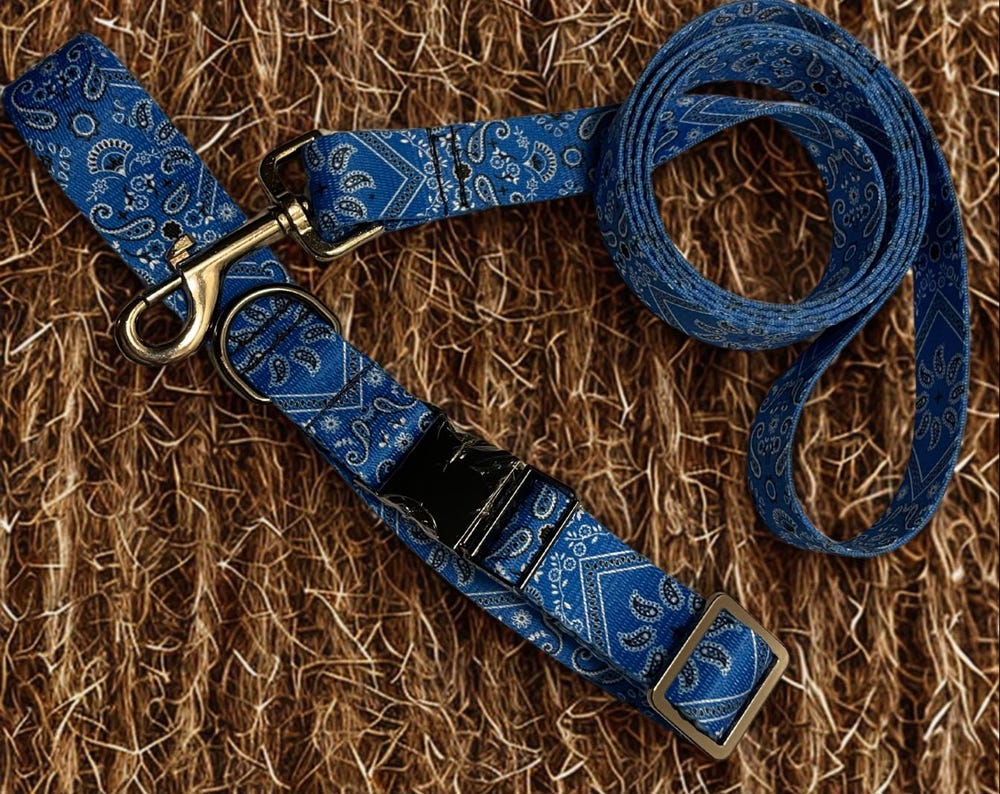
For a first dog's walking kit, you need three things: a collar that fits, a plain fixed leash, and ID on the collar from the first day. Everything else can wait until you've met the dog you actually brought home.
That's the honest version. The pet shop aisle will tell you otherwise. Here's what goes on the list, how to size it, and what to leave on the shelf for now.
What does a first dog actually need for walks?
Keep it short. This is the whole starter list:
- One flat collar in the right size, with a buckle you can open and close easily.
- One fixed leash. Not a retractable. A plain lead with a handle at one end and a snap at the other.
- ID. Your dog's name and your phone number, on the collar, before the first walk.
- A harness, only if you need one. Very small dogs, strong pullers and dogs with neck or breathing problems often do better walking on one.
- Poop bags. Not glamorous. Essential.
That's it. You can add a spare leash, a second collar or a fancy print later. In the first few weeks you're learning how your dog walks, what they pull towards and how big their neck really is. Buy for the dog in front of you.
How do you pick the right collar size for a new dog?
Measure, don't guess. Breed lists are a rough guide at best, and plenty of rescue dogs are a mix nobody can name.
- Wrap a soft tape around the neck where the collar will sit, about halfway down, not tight against the head.
- Add two fingers' worth of room. Slide two fingers flat under the tape, then read the number.
- Match it to the chart on our size guide:
- Small: 8 to 11 inches - Medium: 11 to 14 inches - Large: 14 to 18 inches - XL: 18 to 22 inches - XXL: 22 to 28 inches
Each collar adjusts about four inches inside its size. That's your wiggle room. If your number lands right on the line between two sizes, go up.
Once it's on, do the two checks. Two fingers should slide under the collar snugly. And when you ease the collar towards the ears, it should stop at the head rather than slip over it. A new dog in a strange house is more likely to bolt than at any other time, so this check matters most in week one.
Bringing home a puppy? Buy the size that fits now, not the size they'll be at a year old. A collar that's too big slips off.
Which leash should you start with?
A plain, fixed-length leash with a strong snap. It gives you a steady feel for where your dog is and what they're doing, which is exactly what you need while you're both learning.
Skip the retractable for now. The thin cord is hard to grip, it teaches a dog that pulling earns more line, and it's no good in a busy street.
As for length, most people do well with something in the middle. Shorter for city pavements, longer for open paths. Our guide on how long a dog leash should be goes into the details.
Before every walk, flick the snap open with your thumb and let go. It should spring shut on its own, every time.
Should your dog wear ID from day one?
Yes. The first days in a new home are when dogs go missing. A gate left open, a startled dog slipping through a door, a walk in a neighbourhood they don't know yet. If your dog gets out, the collar is the first thing a stranger looks at.
Put two things on it:
- Your phone number. This is the part that gets your dog home.
- Your dog's name. It helps a stranger call them over and calm them down.
You can do that with a hanging tag or with embroidery stitched into the collar. Embroidery is $2 a letter here, it can't fall off, and it doesn't jingle.
If your dog came from a shelter or breeder with a microchip, make sure the chip is registered to you, too. The collar is what a neighbour sees. The chip is what a vet or shelter scans.
What can you skip until you know your dog?
A few things are worth waiting on:
- A wardrobe of collars. One good one is enough to start. You'll know which prints and widths suit your dog after a month of wearing one.
- A wide or specialist collar. Strong pullers and thick-necked dogs can benefit from a wider strap, but you won't know which you've got until you've walked them for a couple of weeks.
- Long training lines and double leads. Useful later, confusing now.
- Anything you can't size yet. If your dog is still filling out or losing a shelter coat, buy the basics and re-measure in a month.
When you're ready to add more, a harness is easy. On our collars it's a Style option for $8 more, sized by chest rather than neck.
Ready to kit out your first dog? Start with one collar and one leash, sized to the dog you actually have. Our matching collar and leash sets cover both in one go. Collars start at $20, leashes are $22, and everything is handmade.
FAQ
Should a new dog wear a collar all the time?
Keep it on whenever your dog could get out: walks, the garden, the car, visitors at the door. That's when the ID earns its place. Check the fit every few days for the first couple of weeks, especially on a puppy or a dog whose weight is changing.
What if I buy the wrong size?
Measure again and compare it with the chart. If it's genuinely the wrong band, our size guide covers it: send it back within 30 days and we'll adjust it for free.
Do I need a harness as well as a collar?
Not always. The collar carries the ID and is fine for walking most dogs. Add a harness if your dog is very small, pulls hard, or has a neck or breathing issue. Our collar vs harness guide helps you decide.
Pick a print for your new dog from our handmade dog collars.