
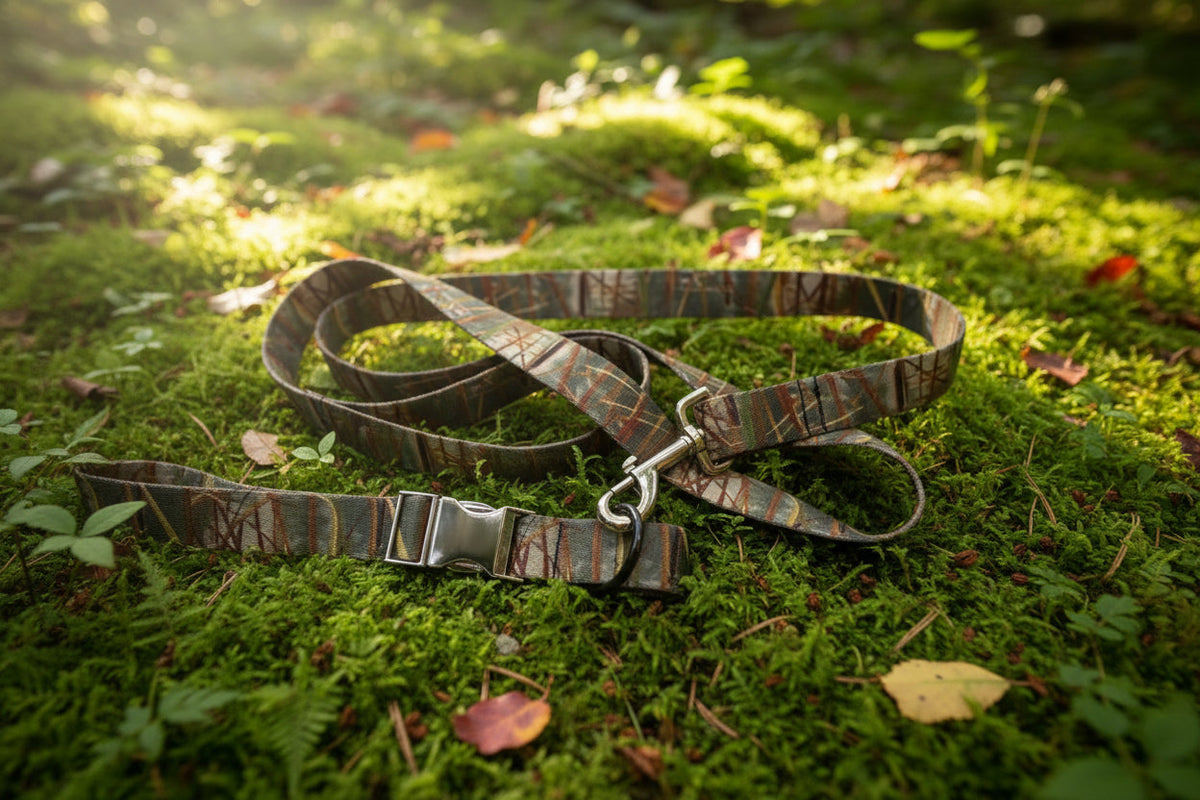
A handmade dog collar costs more than a rack collar because almost all of that cost is labour, hardware and sizing — not the pattern. You're paying for a collar cut and stitched to your dog's neck, with metal picked to survive a lunge.
That's the short answer. The longer one is worth knowing, because "handmade" gets printed on a lot of things that aren't, and the differences that matter are all things you can check yourself.
What does "handmade" actually mean on a dog collar?
It means a person cut the webbing, wrapped the fabric, ran the stitching and set the hardware, one collar at a time.
For us it also means made to order. The collar doesn't exist until you buy it, so it's built to the size you gave us rather than pulled off a shelf. That's why an order takes a few days instead of leaving the same afternoon.
Mass-produced is the opposite, and not in a sinister way. A factory runs thousands of identical collars, which is the only way the price gets that low. The priorities are just different: a factory optimises cost per unit across a production run, a maker optimises the one collar in front of them.
The gap between those two shows up in four places — the webbing, the stitching, the hardware, and the fit.
What are you actually paying for?
- Labour, mostly. Cutting, wrapping, aligning the pattern, stitching, setting hardware, checking it. On a handmade collar that's most of the price, and there's no volume to spread it across.
- Hardware that's chosen, not sourced by price. Ours is solid cast and weld-free, which matters because a weld is a seam and a seam is where a D-ring opens up. It's the single most expensive part of a well-made collar and the first thing cut when a collar has to hit a price.
- The webbing under the print. The fabric is the part you fall for; the strapping underneath is the part doing the work. A collar is only as strong as what's carrying the load between the buckle and the D-ring.
- A size, rather than a size range. Made to order means the adjustment range starts near your dog's actual measurement instead of trying to cover three dogs at once. Our size guide walks through measuring properly, including what to do if your dog lands between sizes.
- Being able to ask for something. Embroidered name and number, a specific print, a set that matches. A custom order is a conversation with a person, which is not a thing a production line can offer you at any price.
Where do mass-produced collars cut the cost?
Nobody sits down to design a bad collar. Cost just has to come out somewhere, and it tends to come out in the same order every time.
Hardware goes first. Thin bent-and-welded D-rings, light buckles, plating over soft metal. Identical in a photo, completely different the first time a big dog hits the end of a leash.
Then stitching. Fewer passes, no reinforcement at the stress points, thread chosen for machine speed rather than abrasion. Stitching rarely fails on day one — it fails after eighteen months of a dog scratching the same spot.
Then the finishing. Webbing ends that weren't sealed properly start to fray, pattern alignment drifts, the buckle sits slightly proud. All cosmetic, right up until the fraying reaches the stitch line.
And then sizing. One collar stretched across too many necks means half the dogs wearing it are at the far end of the adjustment, with three inches of tail flapping or almost no room left to let it out.
How do you tell the difference in your hand?
You don't need to be a maker to check a collar. Sixty seconds and these five things will tell you most of it:
- Weigh the hardware. Solid cast metal has an obvious heft. Light, hollow-feeling hardware is hollow-feeling for a reason.
- Look at the D-ring where it closes. A visible seam or a line of weld is the weak point. A one-piece cast ring doesn't have one.
- Check the stitching at the stress points — where the D-ring is captured, and where the buckle is anchored. You want dense, repeated stitching there, not one lap of the same thread used everywhere else.
- Flex the buckle. Press the release and squeeze the sides. Real flex or a gritty click means it's thin.
- Run a thumb along the webbing ends. Sealed and finished, or already starting to fluff?
Do this to the collar your dog is wearing right now. It's a faster education than any article, including this one.
Is a handmade dog collar worth the money?
For some dogs, plainly yes. For others it's a preference, and it's fair to call it one.
It's worth it if your dog pulls, swims, rolls in things, is big enough that hardware failure actually matters, sits between standard sizes, or wears the same collar every day for years. In those cases you're not buying a nicer collar, you're buying one that doesn't become a problem.
It matters less if your dog is small, indoors most of the time, and wears a collar mainly to carry tags. The strength argument mostly falls away there — though the fit argument doesn't, and a collar that fits is the difference between one your dog forgets about and one they scratch at.
Then do the boring maths. A collar worn daily for two years costs less per month than a bag of treats, and that's the timescale a well-made one should be judged on. Replacing a cheap collar twice a year is rarely cheaper, and it's never more pleasant.
Ready to see the difference? Have a look at our handmade collars and check them against the five-point list above — that's exactly how we'd want you to buy one.
FAQ
Does handmade mean it's less consistent than a factory collar?
Consistency comes from the pattern and the process, not the volume. Every collar is cut from the same pattern and built the same way — the difference is that each one gets looked at by the person who made it before it goes in a box, which is the step a production line replaces with a sampling rate.
How long should a handmade dog collar last?
Years, for most dogs, if you keep it clean and check the hardware now and then. Hand wash in cool water and air dry flat, and look at the D-ring and the stitching every few months. Collars usually give plenty of warning before they fail — fraying, a stitch line opening, a buckle that's gone gritty.
Is a matching collar and leash set better value than buying separately?
Usually, and for a practical reason rather than a pricing one: fabric runs out. Buying a collar in spring and trying to match a leash to it in autumn often isn't possible, so if you want the pair, buy the pair. Our matching sets are made from the same fabric run.
Still deciding? Browse the collars and start by measuring your dog — the fit matters more than anything else on this page.